Roads, Mobility, and Geographical Memory
And Their Children After ThemRoads, Mobility, and Geographical Memory is a recurring concept in the novel: movement gives Heillange’s inhabitants access to work, pleasure, and elsewhere, while the routes they travel bind those possibilities to a landscape they know by heart. Travel is not simply escape. Daily journeys turn the valley into a practical map, and repeated roads become records of attachment, loss, and return. The same mobility that carries workers across a national border or draws a young man toward someone he cannot leave also reveals the limits imposed by the region’s economic and social geography.
Movement as the Structure of Everyday Life
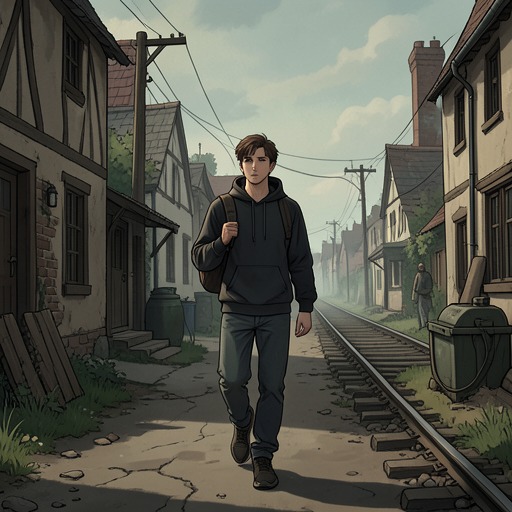
For Stéphanie, the valley is legible through a lifetime of trips. She has crossed it on foot, by bicycle, scooter, bus, and car; like the other young people around her, she experiences life as a succession of journeys to school, friends, town, the beach, the area behind the pool, or a small park. Adults follow their own itineraries, going to work, running errands, visiting a babysitter, taking a car to Midas, or going to the movies. Each desire involves a distance, and each pleasure requires fuel. The result is a way of understanding place as a road map: memory takes geographical form because lives are made from repeated movements between particular destinations.
That map is not abstract. Familiar roads hold separate episodes and emotional histories, so a landscape can be known at once as a network of routes and as a personal past. Hélène’s drive home from a swim makes this connection especially clear. She takes her time, passing her parents-in-law’s house and recalling a Christmas party with the family, then driving by the fire station and the primary school. Every street and building carries a memory. The ordinary drive becomes a passage through her own history; its calm ends when smoke and the smell of burning plastic and gasoline draw her toward the fire consuming the motorcycle near her home. Place links recollection to immediate danger, turning a familiar route into the approach to a rupture.
Work, Borders, and Unequal Mobility
The valley’s roads also carry the pressure of economic change. Near the border, settlements that had seemed moribund begin to revive as Luxembourg, short of workers, recruits people from neighboring areas. Commuters travel abroad for better pay, while the relatively meager social services there mean that work and residence remain divided across the frontier. Their journeys help sustain schools, reopen a bakery beside a shuttered church, and encourage new houses to appear in the countryside. Each morning and evening, workers crowd trains and highways with bags under their eyes. Mobility brings employment and visible renewal, but its daily rhythm is also evidence of the need to seek subsistence elsewhere. The road connects places without dissolving the economic difference between them.
Housing offers a more constrained picture of movement. The ZUP Residential District where the Boualis live is a small complex of fewer than a dozen low buildings and three fifteen-story towers, including Manet tower. Built during the prosperous Trente Glorieuses, it has been losing tenants. Some residents extend their apartments into empty units, while rust, peeling stucco, satellite dishes, and clotheslines mark the aging towers. Those able to leave have gone to Luxembourg, Île-de-France, or their countries of origin; some of the most fortunate have bought houses after years of sacrifice. The planned demolition will proceed wall by wall, reducing fifty years of life to rubble. Yet families who have lived there for decades continue to make the district a lived-in home. Here, mobility separates those who can depart from those who remain, while redevelopment treats a place of accumulated lives as a structure to clear.
Routes as Habit, Desire, and Confinement
Anthony’s motorcycle routes turn movement into a private discipline. The dangerous riding of his earlier years—wheelies, zigzags between cars, and last-minute maneuvers—has given way to a search for invisibility and precision on his Yamaha 125. He repeats carefully chosen routes between his mother’s home, the sailing club, school, and his father’s place. Another route runs from the E.Leclerc retail chain through downtown to the Old Power Plant. He values their geometry, momentum, and opportunities for complicated maneuvers, refining each ride toward a fluid, clean line. The roads are not interchangeable space: their shapes and sensations give movement a practiced form, and repetition offers a kind of mastery.
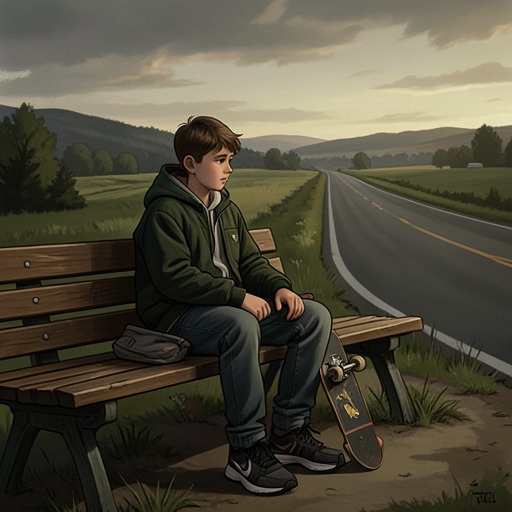
That mastery fails when Anthony cannot leave the lakeshore after seeing Stéphanie. He rides through the forest and along the road in a circuit he does not recognize as an orbit around her presence. The motion that normally offers him precision and pleasure becomes restless repetition: he keeps moving but cannot bring himself to go. Chilly air, goose bumps, nervous fatigue, and dried blood on his chin make the body’s unease present within the landscape. Passing the Léo-Lagrange recreation center for a second time, he stops, checks his face in the mirror, hides his motorcycle in the forest, and heads for the campground. The route does not take him away from his fixation; it circles him back toward an uncertain encounter.
Hacine’s return to Heillange similarly makes distance visible as both change and continuity. After driving alone from the morning, he stops near Niort for coffee, having traveled without speaking and obeyed the rules of the road. The journey brings him home with money in his pockets, an expensive Armani shirt, and an altered appearance, but an empty heart. Back beneath the ZUP towers, he recognizes the courtyard, dust, and shady places where he used to be bored. The familiar setting carries the force of home despite his long absence and the rumors that precede him.
Walking downtown after three days of near silence, Hacine finds Heillange apparently unchanged, then notices the details that contradict that impression: a new kebab stand, a video game store, an abandoned bus shelter, and fresh billboards advertising Parisian perfumes and cheap shoes. He enjoys streets he knows, and the distance he has traveled lends him a temporary sense of importance among those who stayed. Later, driving slowly with one elbow out the window, he savors the familiar landscape in a mood of suspension. His return therefore joins two kinds of knowledge: the intimate recognition of home and the altered perspective of someone who has been away.
Redevelopment and the Imagined Future
The town’s changing routes and destinations reflect competing plans for its future. Downtown Heillange is being pulled between businesses moving to the outskirts and costly renovation of the historic center. With factories nearly gone and young people leaving for lack of work, City Hall turns toward tourism and investment: improvements to the campground, sailing club, and swimming pool; a miniature-golf course; pedestrian streets and bike paths; a proposed iron and steel museum; and support for an amusement park. The plan promises prosperity through investment and debt, while local officials defend the future-facing program against criticism. Mobility here is planned as economic development: visitors, hikers, and customers are expected to move through a renewed town even as the workers who once shaped its politics become a smaller part of the electorate.
The new des Montets enterprise zone gives that vision a stark physical form. Still under construction, it contains warehouses, retail outlets, and recently built offices that resemble stacked containers. Vast parking lots are divided by concrete barriers and dotted with streetlights; at night, they look like an ocean of empty spaces. Anthony and Hacine arrive there after Anthony persists in wanting to try the motorcycle. At the west entrance, five hundred yards of empty lot stretch before them. The setting promises modern activity—offices, services, computers, and open space—but, in its unfinished state, presents emptiness and distance instead. Across the novel, roads and development projects promise movement toward work, pleasure, or a new economy. Their meanings remain inseparable from the lives already mapped onto the valley: mobility can sustain a household, express desire, rehearse a skill, or bring someone home, but it cannot make geography cease to hold memory.